

It was a few weeks ago.
I’m scrolling Instagram and I land on a guy shadowboxing in the middle of a Paris street (shadowboxing: throwing punches at nobody. basically air guitar, but for boxing). I don’t know it yet, but this guy doesn’t exist. And he’s about to make me lose an argument at a dinner party, my status as the family AI expert, and a little bit of my pride.
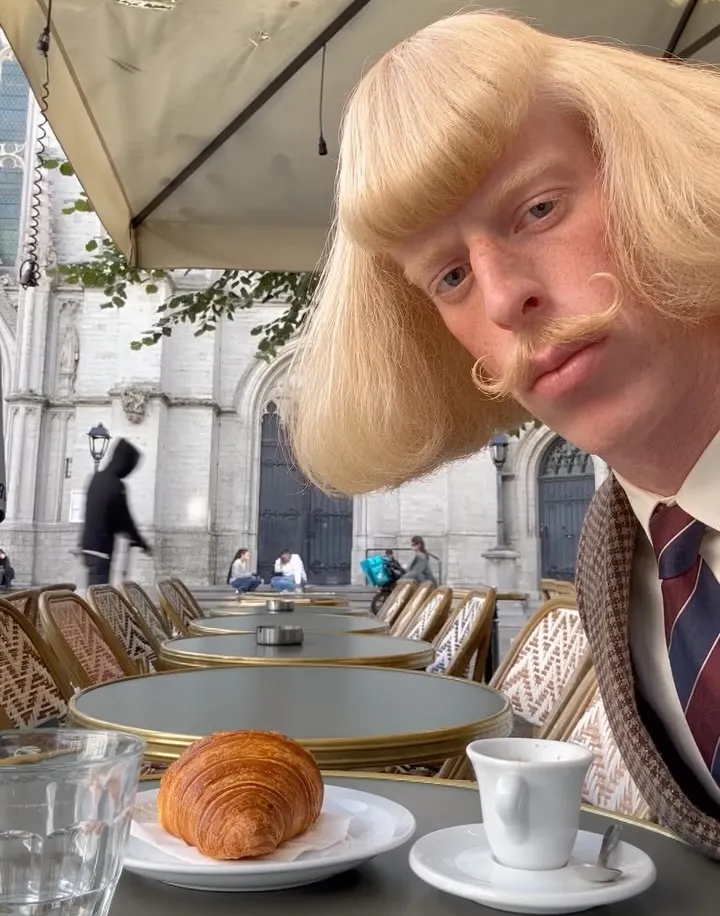
The guy in question has a brown tweed suit, a tie, a platinum-blond bowl cut and a mustache curled at the tips, and he looks about six and a half feet tall. Picture Lord Farquaad from Shrek, but blond, tall, and punching thin air on a sidewalk. He never smiles.

Ladies and gentlemen: Jean Philanthrope
But he is very, very hypnotic. I watch, I send it to someone, and the algorithm, which figured out I was hooked before I did, serves him up again. And again. And when I see a guy who looks like he walked straight out of a DreamWorks movie shadowboxing his way across Paris, I click. Jean-Phil (real name @jean_philanthrope) boxes in front of the Eiffel Tower, in cafés, surrounded by passersby. Same suit, same moves, every time. And it’s working pretty well: 235,000 followers as I write this.
I thought I’d figured out the concept. A guy with an incredible look, a character, a format that repeats, and one smart move: he never says a word. And when you don’t talk, you talk to everyone. It’s the Tibo InShape playbook: you make videos where you don’t say anything, just a visual gag, and the whole world becomes your audience. (Tibo is a French fitness YouTuber. you’ve probably watched his Shorts without ever knowing he was French, which is exactly the point.) He became France’s most-followed creator by winning over India with funny Shorts and not a single word.
Back to Jean-Phil. He’s obviously French (nobody in Ohio is named Jean-Philanthrope), but his audience is global. I thought that was clever.
One day I go to his profile, and there’s a link to a crypto token in his bio. And I’m like: ugh, come on. All this just to pump your own coin and sell it later... So he wasn’t doing it for the love of the art. You’re going to tell me “well, obviously.” Yeah, well, I still believe some people do things just for fun. So in my head, this guy is an influencer who found a shady way to monetize his character. A human in a costume, with a plan.
Oui Madame.
And then came that dinner. The night everything flipped.
I bring it up at the table. Around me: friends who, like me, get paid to understand what goes on inside other people’s heads (it’s a real job, I swear), and even a researcher. They’d all seen Jean-Phil. They’d all bought it. The only one who doesn’t is the only one of us who doesn’t work in marketing at all:
“Dude. Come on. That thing is AI.”
“No way.”
We argue. He pulls out his phone and zooms in on the videos. There, behind Jean-Phil, a sign with blurry lettering. There, a passerby stops walking, except the hood of his coat keeps going without him. And there. And there. We lose the argument. All of us.
My friend is gloating, and he makes it very clear that we’re a bunch of losers who got played, when we’re supposed to be the last people on earth to fall for AI. Us, the “industry professionals.”
Quick detour where you actually learn something: whether you get fooled by AI-generated content or not comes down to AI literacy. Some people are trained in it, some aren’t. And you can get better at it, by understanding how it works, by paying real attention to what’s behind those beavers giving room tours. And let me tell you, we were not AI literate. Not even a little.
What got us was the grime. Nothing’s perfect in these videos: the suit is wrinkled, the shadows fall wrong, the street corners are a bit dirty. It feels real. It looks like somebody’s iPhone footage. Those AI fruit soap operas where everyone cheats on everyone? Anyone can tell they’re AI. (in France, we have Skibidi Tentafruit: basically Temptation Island, with pineapples.) Here, the AI learned to fake the flaws, and the flaws were what sold us.
And there’s a second reason, the one that changes everything. Until now, making a believable AI video was possible. But making the same character across fifty videos was studio work, with 3D and a whole team. Today, tools like Higgsfield or Runway learn a face from a set of photos and reproduce it exactly, scene after scene. Same nose, same mustache, same suit, fifty different backdrops. One video, you can doubt. Fifty, and you relax. Consistency manufactures proof.
(a detail nobody noticed, me included: in Greek, philanthrope means “lover of humans.” someone has a sense of humor.)
Okay, the token. That’s the surface layer of the story, the part you get right away. The link pointed to $JEANPHIL, launched on Solana through a platform called, I’m not making this up, Pump.fun. According to the crypto press, it hit a valuation of several million dollars within days. And Jean-Phil quickly had rivals: Archibald Brown, the English boxer who trash-talks him in his captions (roughly: come to the UK and see what happens), then others. Each with his own mustache. Each with his own token.

the $JEANPHIL token stats, in case you can make sense of them.
What Jean-Phil is doing looks a lot like a pump and dump. (at least the name is honest.) You know how it works. You create your own coin, you manufacture virality, and the more people pile in, the higher it goes. You pump, and pump, and pump. The day you sell, you’re the first one out, because you’re the one controlling the hype. And the people who showed up because “Jean-Phil has a vibe” are the last to sell. They’re also the ones who lose their money. Same story every time.
At its peak, his coin was worth 12 million dollars. Not bad for a guy who doesn’t exist.
(nobody knows who’s behind the account, and whoever it is says they haven’t sold a thing. I’ll just point out that as of September 30, the bio only says “Oui Madame.” the link is gone.)
But actually, that’s not the most interesting part.
This is the first time I’ve ever been fooled by an AI video. And I know this makes me sound like I think the world revolves around me, but it matters.
In my family, I’m the tech expert. Okay, the bar isn’t high. Knowing how to right-click basically puts you in the top three. But still, I’m the one who explains new apps and trends... to my parents. The one who resets their passwords. The one who taught them how to forward an email (two months ago. they’re fast learners).
My dad sends me videos of earthquakes and landslides in India and Pakistan that never happened, and that are badly made. And I explain, in my best I-know-what-I’m-talking-about voice: look, that doesn’t add up, and that, right there, is AI. I use these tools every day. I was making posters on DALL·E back when it first landed in France.
And I got fooled just like my dad.
In the moment, I was embarrassed. Then it made me laugh, because for the first time, I knew how my dad felt every time I lectured him. (and I have to admit: I also had a little respect for whoever runs Jean-Phil’s account. it’s really well done. great job.)
If I fell for it, along with a whole table of people who do this for a living, then the technology is ready to fool pretty much everyone. People already struggle to tell a fake image from a real one. Music too: in a Deezer/Ipsos study of 9,000 people, 97% couldn’t tell an AI-generated track from a human one. Video was the last line of defense. It just fell, taken down by a mustache and a nice three-piece suit.
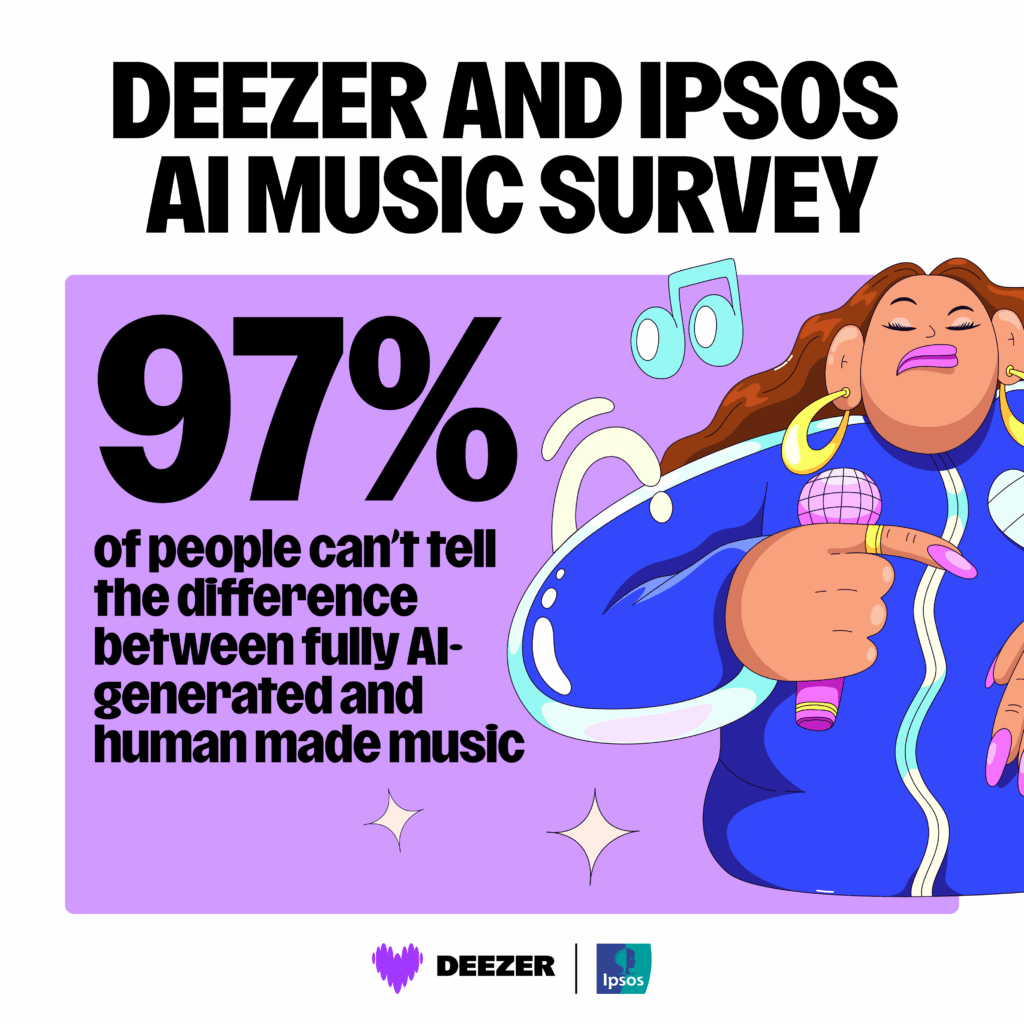
Ipsos × Deezer, 2025
But the real story is in the comments. I’m not the only one who got fooled.
Everyone. Got. Fooled.
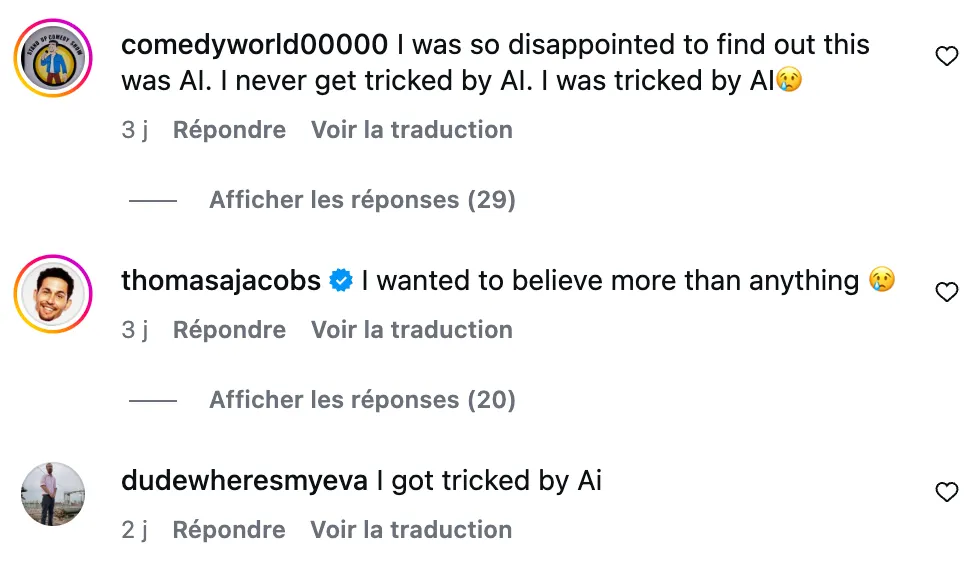
the comments under Jean-Phil’s latest video
It’s a shared first time. All the young, very online people who thought they were immune, who could always tell real from fake, fell for it. It’s a collective defeat. And we’re living through it together, in the comments.
Nobody’s angry. Everyone’s disappointed. Disappointed the way you are with someone you believed in.
I call it the Santa Claus effect: the moment you find out that someone you liked never existed, and you’re not angry, just disappointed. Remember when your friend Léo told you, right in the middle of recess, that Santa was actually his uncle Philippe? No? Okay, maybe that’s just me, but you get the idea. I didn’t cry. Mostly, I thought about my family and the lie they told me. Then I realized everyone had been fooled. That I was just joining the great Santa lie. Or rather, switching sides: now it was my turn to lie to the next generation and play along. I was disappointed, but I kept loving Christmas.
Here, I kept loving Jean-Phil and his content. I just stopped believing in him.
And that’s dizzying. Triggering an emotion in a human being is the most powerful thing you can do in communication, in marketing. Anywhere. We've known how to trigger negative emotion for ages: ragebait is easy, we know which buttons to push and which crowds will react. But here, a character who doesn’t exist created attachment. A positive feeling, the kind you have for someone like you, someone you’d love to bump into on a street corner, casually shadowboxing.
Okay, sure, you’re going to tell me we’ve always gotten attached to fictional characters, and that the Michelin Man is over 100 years old. True. But the Michelin Man never pretended to be a real guy shadowboxing in a seafood restaurant (what even is that sentence). What’s changing isn’t that we love characters. It’s that we no longer know they’re characters.

the Michelin Man had a glow-up
Jean-Phil is a prototype. He's a preview of what's coming: characters built for us to get attached to. Consistent from one video to the next, with rivals, collabs, storylines, and one reason to exist: serving a financial interest. Not sharing something. Not building a community. Just looking enough like the real thing to hit us right in the heart.
The question(s) it leaves us with
So the question isn’t whether we’ll be able to spot the fakes anymore. We won’t. A whole table of professionals is proof (I, at least, exist). The question is how many Santa Claus effects we can take, and what we’ll do with our attachments once we know any one of them could have been manufactured.
The other question is what a society looks like when our first instinct, every time we discover something, is to assume it’s fake, and built to get something out of us.
We’ve spent ten years learning to distrust what makes us angry online.
Now we’ll have to learn to distrust what makes us smile.
Raf
P.S. When I’m not getting played by boxers who don’t exist, I study young people who very much do. That’s what we do at obv studio ↓